
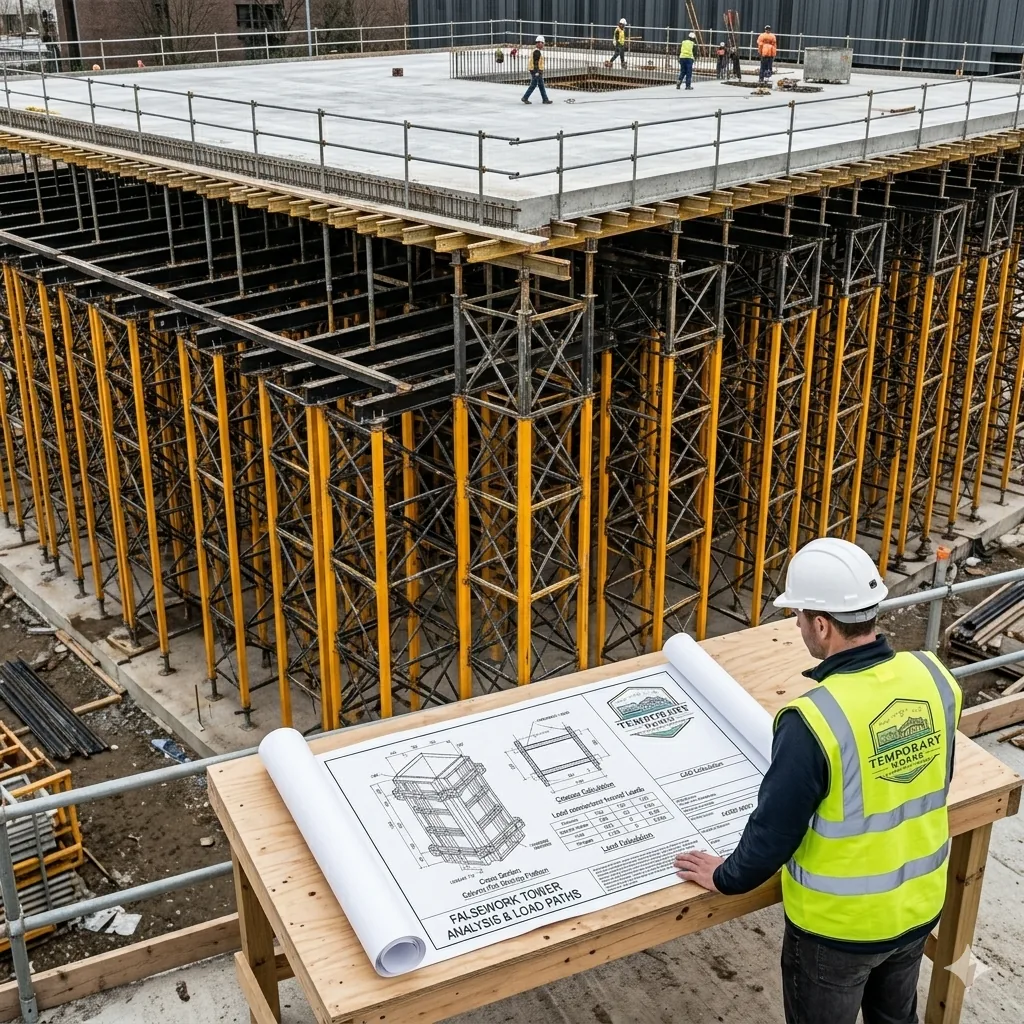
This is a checklist, not a ranking
Lists of “top BS 5975 compliant firms” circulate because contractors need a short way to appoint a designer. The 2024 standard does not publish a league table. BSI split the former BS 5975:2019 on 25 February 2025 into BS 5975-1:2024 (management procedures for the control of temporary works) and BS 5975-2:2024 (falsework). Compliance sits with the duty holders on the job — Designated Individual, Temporary Works Coordinator, designer and checker — not with a marketing claim on a homepage.
This article is the vetting list we use when a principal contractor asks how to tell a competent appointment from a brochure. It is written for people holding the register, not for search engines that want a numbered top ten. If a firm cannot answer these questions in writing, they are not ready to sit on your temporary works procedure.
1. Named engineer, not a generic inbox
Ask who will actually design or check the item, and verify them. For a Chartered Engineer that means Engineering Council registration you can look up, not a logo. Temporary Works Consulting & Design Ltd designs are led by David J. Miller, CEng MICE, registration 094002192. PMI-CP (PMI ID 10695576) is useful where the temporary condition is also a programme and change problem. CITB TWC/TWS training is competence for the site roles; it is not a substitute for the designer.
If the quote comes from a business development desk and the drawings arrive unsigned, you do not have a designer appointment. BS 5975 expects the design to be attributable.
2. Check category before the price
Cat 0 to Cat 3 is how the standard scales independent checking to risk and consequence. A firm that prices every scaffold as Cat 0, or every excavation as Cat 3, is not reading the brief. Ask: who proposes the category, who accepts it, and who is excluded from checking their own Cat 3 work. The same organisation must not independently Cat 3-check its own design.
HSE still requires temporary structures to be designed, installed and maintained for foreseeable loads and inspected by a competent person. The check is how that duty is evidenced before the permit-to-load.
3. The pack has to run the permit
A compliant pack is not a calculation PDF with no sequence. It should carry the design brief, loadings, drawings or sketches, residual risk, and the conditions the TWC will write on the permit to load, alter or strike. If the TWS cannot inspect against it, the pack is not finished.
Ask for a redacted example. Look for document references that will sit on the register, revision control, and a clear statement of what the design does not cover. Missing ground information, missing imposed loads and missing interfaces are the usual holes.
4. Procedure, register and RAMS in the same conversation
Part 1 of the 2024 standard is the management system. A designer who cannot talk about the register, the Designated Individual and the TWC is only selling drawings. A contractor who has a 2019 procedure still on the wall is already behind the document the industry now cites.
RAMS that contradict the drawings are a control failure, not a paperwork mismatch. Ask whether the firm will comment on method and ITP hold points against the pack they issue. Construction remains the UK’s highest-fatality sector: HSE recorded 25 construction deaths in 2025/26, with falls from height the leading cause. Temporary works that create access, edges and loads belong in that method.
5. Insurance, scope and what they will not do
Ask for professional indemnity and public liability, and for the scope exclusions. Temporary Works Consulting & Design Ltd carries £2m PI and £10m PL. That is not a substitute for competence, but an appointment without it is a commercial hole in the procedure.
Be wary of firms that will “stamp” a supplier layout without a brief, or that treat standard solutions as covering designed scaffold, public-interface fans or working platforms for tracked plant. Standard solutions are used where they fit. They are not stretched.