
What the BRE470 Piling Mat Designer is
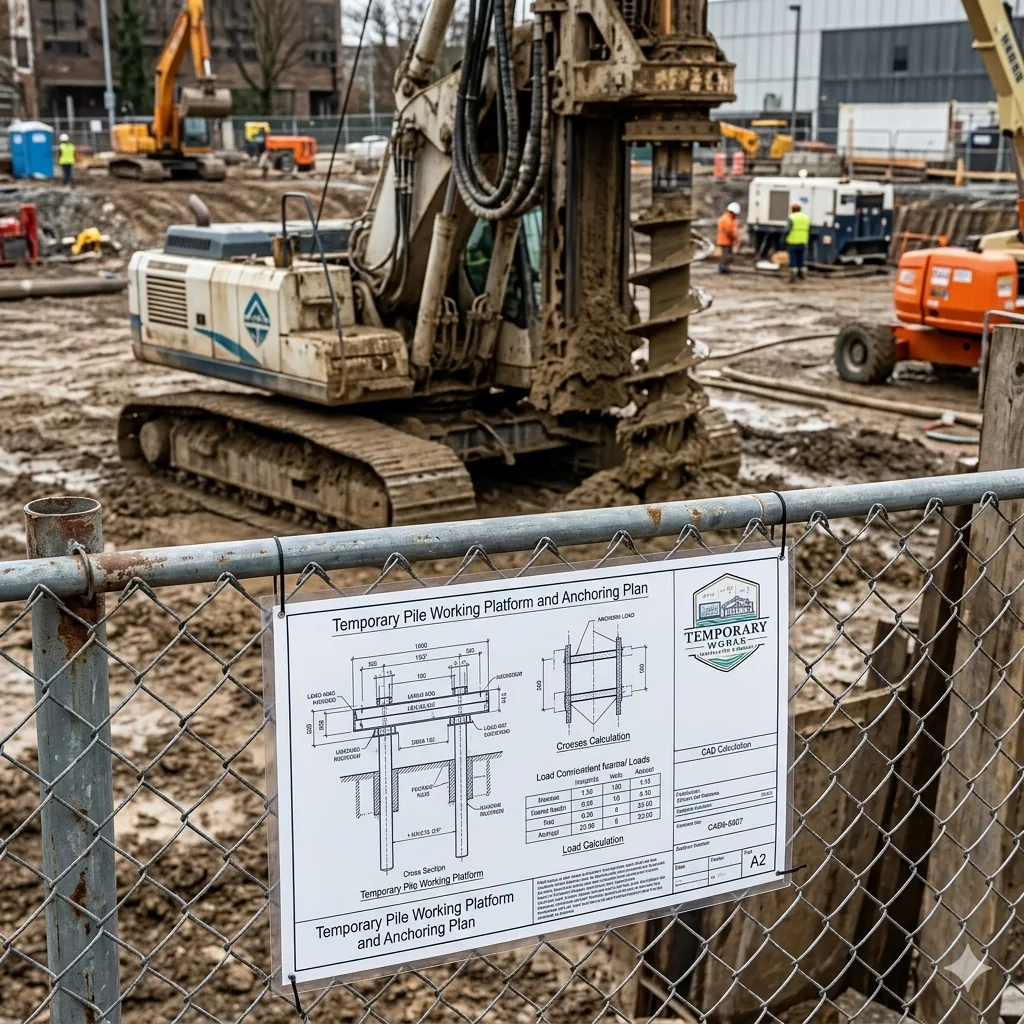
A working platform for tracked plant is temporary works. BRE Report 470, Working platforms for tracked plant, is the UK guidance contractors, designers and Temporary Works Coordinators still use to size a granular platform so a piling rig, crane or other tracked machine can operate without punching through. The calculation is not a spreadsheet novelty: it is the difference between a mat that has a stated basis and a pad of stone that nobody has checked against the plant that will sit on it.
The BRE470 Piling Mat Designer on this site is an automated calculation tool for that assessment. You select or enter the plant, the track or outrigger loads, and the ground information you actually have. The tool runs the BRE 470 method in the browser so appointed persons, TWCs and piling contractors can test thickness, bearing and sensitivity before anyone orders stone. Unlimited calculations are free. When the platform has to be issued as a design — signed by a Chartered Civil Engineer, with residual risk and permit-to-load input — that pack is quoted separately.
The tool does not invent ground conditions. If the site investigation is thin, the output says so. If the rig is not in the pre-loaded list, you enter the loads from the manufacturer’s data. The point of automation is speed and repeatability, not a substitute for the judgement that BRE 470 still requires of a competent person. A mat specified from a round number “that we always use” is not a BRE 470 design; neither is a calculation that uses the travelling case when the governing load is the operating case with the mast up.
Who it is for
Piling contractors use it in the week before mobilisation, when the mat specification is still moving and standing time is expensive. Appointed persons use it for crane mats and outrigger pads that have to be consistent with the lift plan. Temporary Works Coordinators use the signed pack as the register item for the working platform — category scaled to risk under BS 5975 — so the permit-to-load has a design behind it rather than a verbal “it will be fine”.
Principal contractors on data centres, substations, overhead-line compounds and structural alterations use the same workflow: run the numbers, then ask for a signed issue when the platform is on the critical path. The designer is David J. Miller, CEng MICE. The practice carries professional indemnity for the signed work. The free tool is information; the pack is the design.
Who it is for
- Piling contractors who need a platform before the rig mobilises
- Appointed persons and crane coordinators specifying mats and outrigger pads
- Temporary Works Coordinators holding working-platform items on the register
- Groundworks contractors building the mat and needing a clear permit-to-load basis
Methodology
- 01
Plant and ground
Select one of the pre-loaded rigs or enter track pressures, outrigger loads and geometry from the plant data. Ground parameters come from the site investigation you have — not from a default soil that makes the mat look thinner than it should.
- 02
BRE 470 platform assessment
The calculation follows BRE 470 working-platform guidance: punching and bearing of the granular layer, with the plant in the operating condition that actually governs, not a lighter travelling case used to flatter the result.
- 03
Sensitivity
Thickness, CBR or undrained strength, and plant load are varied so the TWC can see what happens if the ground is weaker than hoped or the rig is heavier than first assumed. That is the conversation that belongs in the design risk assessment.
- 04
Issue and permit
Where a signed pack is required, calculations, sketches, residual-risk notes and permit-to-load input are issued by a Chartered Civil Engineer so the platform can sit on the temporary works register.
What you receive
- In-browser BRE 470 calculation for piling mats and crane mats
- Twenty-three pre-loaded rigs, plus manual plant entry
- Signed design pack with residual-risk notes when commissioned
- Permit-to-load input for the Temporary Works Coordinator